AdmitMe
All subjects

JAMB and WAEC Biology questions

791 questions with answers and explanations. Tap an option to check yourself.

  1. Question 561· Reproduction· WAEC

    Asexual reproduction by budding is common in

    Show answer

    Answer: D. yeast

    Explanation and discussion
  2. Question 562· Reproduction· JAMB

    After fertilisation, the seed develops from the

    Show answer

    Answer: B. ovule

    Explanation and discussion
  3. Question 563· Reproduction· WAEC

    The male reproductive part of a flower is the

    Show answer

    Answer: A. stamen

    Explanation and discussion
  4. Question 564· Reproduction· WAEC

    Binary fission is a method of reproduction in

    Show answer

    Answer: A. Amoeba

    Explanation and discussion
  5. Question 565· Reproduction· JAMB

    Budding is a method of asexual reproduction in

    Show answer

    Answer: C. yeast and Hydra

    Explanation and discussion
  6. Question 566· Reproduction· JAMB

    Double fertilisation in flowering plants produces

    Show answer

    Answer: A. a zygote and a triploid endosperm nucleus

    Explanation and discussion
  7. Question 567· Reproduction· JAMB

    In flowering plants, the transfer of pollen from anther to stigma is called:

    Show answer

    Answer: B. pollination

    Explanation and discussion
  8. Question 568· Reproduction· JAMB

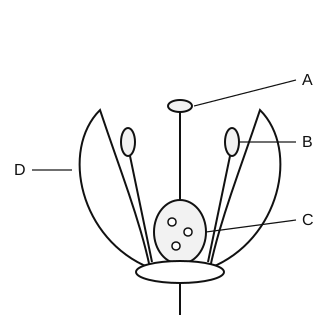
    Diagram for this question

    In the flower shown, the part labelled B, where pollen grains are made, is the

    Show answer

    Answer: C. anther

    Explanation and discussion
  9. Question 569· Reproduction· WAEC

    The female reproductive part of a flower is the

    Show answer

    Answer: A. carpel (pistil)

    Explanation and discussion
  10. Question 570· Respiration· JAMB

    Anaerobic respiration in yeast produces:

    Show answer

    Answer: B. ethanol and carbon dioxide

    Explanation and discussion
  11. Question 571· Respiration· JAMB

    In flowering plants, gaseous exchange takes place mainly through

    Show answer

    Answer: A. stomata and lenticels

    Explanation and discussion
  12. Question 572· Respiration· WAEC

    The respiratory surface of an insect is formed by the

    Show answer

    Answer: B. tracheoles

    Explanation and discussion
  13. Question 573· Respiration· JAMB

    Complete aerobic respiration of one glucose molecule yields about

    Show answer

    Answer: B. 38 ATP

    Explanation and discussion
  14. Question 574· Respiration· JAMB

    Complete aerobic respiration of one molecule of glucose produces about

    Show answer

    Answer: D. 38 molecules of ATP

    Explanation and discussion
  15. Question 575· Respiration· JAMB

    Gaseous exchange in the mammalian lung takes place in the:

    Show answer

    Answer: D. alveoli

    Explanation and discussion
  16. Question 576· Respiration· JAMB

    The alveoli are efficient for gaseous exchange because they

    Show answer

    Answer: D. have thin, moist walls and a rich blood supply

    Explanation and discussion
  17. Question 577· Respiration· JAMB

    The respiratory surface of an earthworm is its

    Show answer

    Answer: C. moist skin

    Explanation and discussion
  18. Question 578· Respiration· WAEC

    Gaseous exchange in fish takes place through the

    Show answer

    Answer: A. gills

    Explanation and discussion
  19. Question 579· Respiration· WAEC

    During a sprint, lactic acid builds up in the leg muscles because

    Show answer

    Answer: A. the oxygen supply is too small for aerobic respiration

    Explanation and discussion
  20. Question 580· Respiration· JAMB

    During vigorous exercise, anaerobic respiration in human muscles produces

    Show answer

    Answer: A. lactic acid

    Explanation and discussion

Practise Biology like the real exam. A timed CBT, your score, and the topics to fix.

Start a Biology test