
Question 21· Motion· JAMB
All subjects
JAMB and WAEC Physics questions: Motion
43 questions with answers and explanations. Tap an option to check yourself.
All topicsCapacitors · 23Change of state · 23Conduction of electricity through liquids and gases · 21Current electricity · 34Dispersion of light and colours · 21Elasticity · 25Electric cells · 21Electrical energy and power · 24Electromagnetic induction · 25Electrostatics · 22Elementary modern physics · 27Equilibrium of forces · 26Friction · 18Gas laws · 24Gravitational field · 24Heat transfer · 22Introductory electronics · 19Light: reflection · 25Light: refraction · 27Liquids at rest · 24Magnets and magnetic fields · 21Measurements and units · 26Motion · 43Optical instruments · 22Pressure · 24Quantity of heat · 24Scalars and vectors · 24Simple a.c. circuits · 17Simple machines · 24Sound waves · 24Temperature and its measurement · 22Thermal expansion · 23Waves · 31Work, energy and power · 29
- Explanation and discussion
Question 22· Motion· WAEC
A ball is thrown vertically upward at 20 m/s. Taking g = 10 m/s², the maximum height reached is
Explanation and discussionQuestion 23· Motion· WAEC
The area under a velocity–time graph represents the
Explanation and discussionQuestion 24· Motion· WAEC
The slope of a distance-time graph gives the
Explanation and discussionQuestion 25· Motion· JAMB
Newton's first law of motion is also called the law of
Explanation and discussionQuestion 26· Motion· JAMB
A car slows uniformly from 25 m/s to rest in 5 s. Find its deceleration.
Explanation and discussionQuestion 27· Motion· JAMB
A car travels 120 km in 1.5 hours. Find its average speed.
Explanation and discussionQuestion 28· Motion· WAEC
A ball is thrown vertically upwards at 30 m/s. How long does it take to reach its highest point? [g = 10 m/s²]
Explanation and discussionQuestion 29· Motion· JAMB
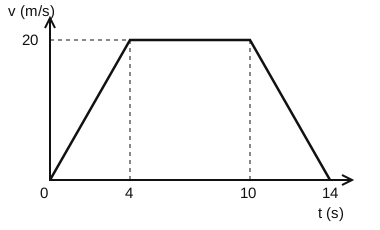
The velocity-time graph shows the motion of a car. Find the deceleration of the car in the last stage of the motion.
Explanation and discussionQuestion 30· Motion· WAEC
A car accelerates uniformly from 10 m/s to 30 m/s in 5 s. Its acceleration is
Explanation and discussionQuestion 31· Motion· JAMB
The velocity-time graph shows the motion of a car. Find the total distance travelled.
Explanation and discussionQuestion 32· Motion· WAEC
A stone dropped from rest falls for 3 s. Its speed is then (g = 10 m/s²)
Explanation and discussionQuestion 33· Motion· JAMB
A ball is projected at 30 m/s at 30° above the horizontal. Find the maximum height it reaches.
Explanation and discussionQuestion 34· Motion· JAMB
A ball is thrown vertically upwards with a speed of 20 m/s. Find the maximum height reached.
Explanation and discussionQuestion 35· Motion· JAMB
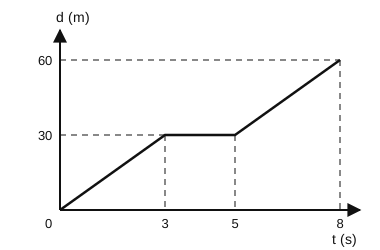
According to the distance-time graph, the cyclist is at rest between
Explanation and discussionQuestion 36· Motion· WAEC
A 2 kg body moving at 5 m/s has momentum
Explanation and discussionQuestion 37· Motion· WAEC
A body starts from rest with a uniform acceleration of 2 m/s². How far does it travel in 5 s?
Explanation and discussionQuestion 38· Motion· WAEC
Newton's third law explains
Explanation and discussionQuestion 39· Motion· WAEC
A stone dropped from the top of a cliff hits the ground 3 s later. How high is the cliff? [g = 10 m/s²]
Explanation and discussionQuestion 40· Motion· JAMB
A body moving with velocity 30 m/s decelerates uniformly at 5 m/s². The distance covered before coming to rest is:
Explanation and discussion
Practise Physics like the real exam. A timed CBT, your score, and the topics to fix.
Start a Physics test